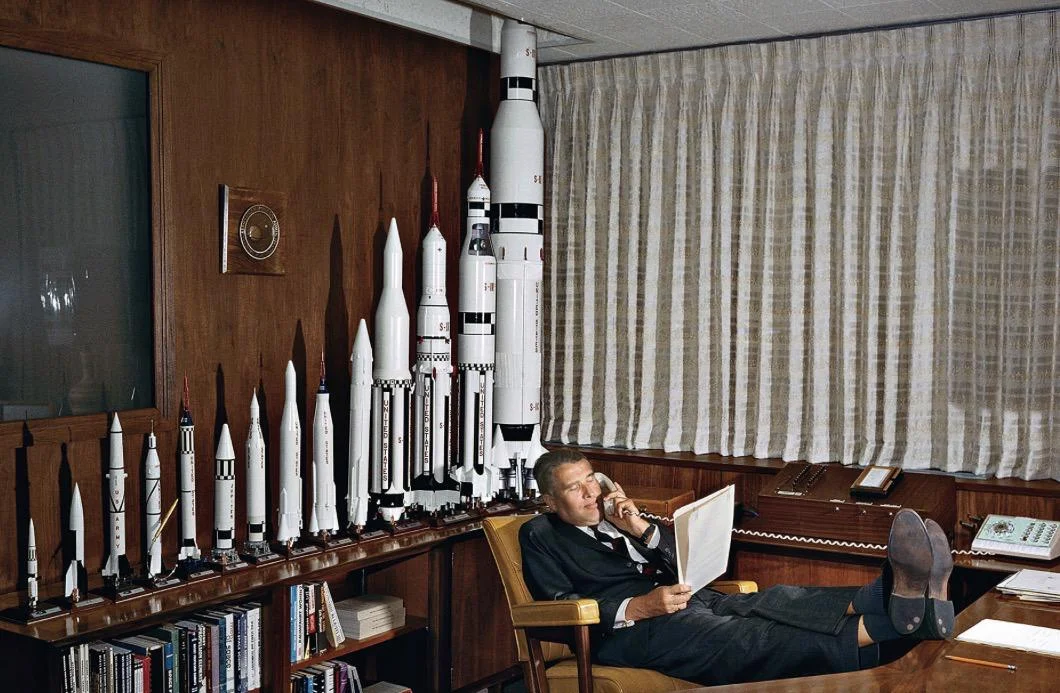
This iconic 1965 photograph captures Wernher von Braun, the architect of the American space program, in his office at the Marshall Space Flight Center in Huntsville, Alabama. Von Braun, a pivotal figure in both Nazi Germany’s V-2 rocket program and the United States’ Saturn V development, is depicted with his feet on his desk, surrounded by a comprehensive scale-model history of American rocketry.
The models lining the wall represent the evolution of NASA's launch vehicles, culminating in the Saturn V, the massive moon rocket that would eventually propel the Apollo missions. During this period, von Braun served as the director of the Marshall Space Flight Center, overseeing the engineering triumphs that defined the Space Race against the Soviet Union.
His transition from a key scientist in the German Wehrmacht to the face of NASA’s Apollo program remains one of the most complex and controversial legacies in modern history. The image serves as a visual testament to the sheer scale of the engineering challenges faced by the United States during the mid-1960s.
By 1965, the Apollo program was in full swing, and von Braun’s expertise was instrumental in shifting the strategic balance of the Cold War toward American technological dominance. This photograph not only documents a moment in the career of a brilliant, albeit polarizing, aerospace engineer but also encapsulates the atmosphere of a nation racing toward the lunar surface.
It provides a rare, candid glimpse into the workspace of a man whose vision fundamentally altered human reach into the cosmos, bridging the gap between wartime missile technology and the peaceful exploration of space.