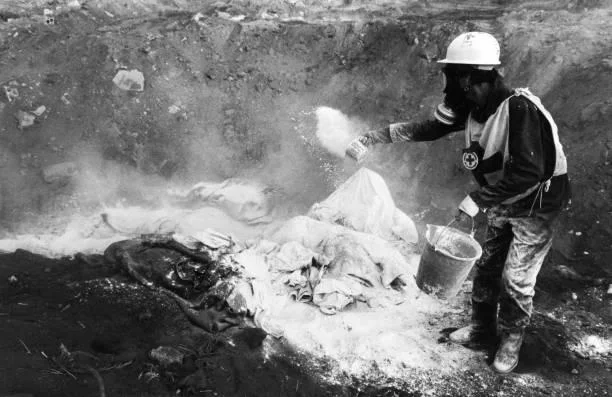
This harrowing photograph captures a Red Cross worker in protective gear, applying lime to the remains of victims during the aftermath of the Sabra and Shatila massacre in Beirut, Lebanon. The massacre occurred between September 16 and 18, 1982, during the Lebanese Civil War.
It involved the systematic killing of between 800 and 3,500 Palestinian refugees and Lebanese civilians by the Phalangist militia, a Lebanese Maronite Christian right-wing group, while the area was under the control of the Israeli Defense Forces (IDF). The image serves as a grim testament to the humanitarian catastrophe that unfolded after the assassination of Lebanese President-elect Bachir Gemayel.
The use of lime was a necessary, gruesome measure to prevent the spread of disease in the sweltering heat of the refugee camp. The international outcry following the massacre was immediate and profound, leading to the Kahan Commission in Israel, which found then-Defense Minister Ariel Sharon indirectly responsible for failing to prevent the slaughter.
The event remains a defining moment in the history of the Middle East, symbolizing the brutal toll of sectarian conflict on civilian populations. This photograph preserves the reality of the tragedy, documenting the grim task of recovery in the wake of one of the 20th century's most controversial and devastating war crimes.