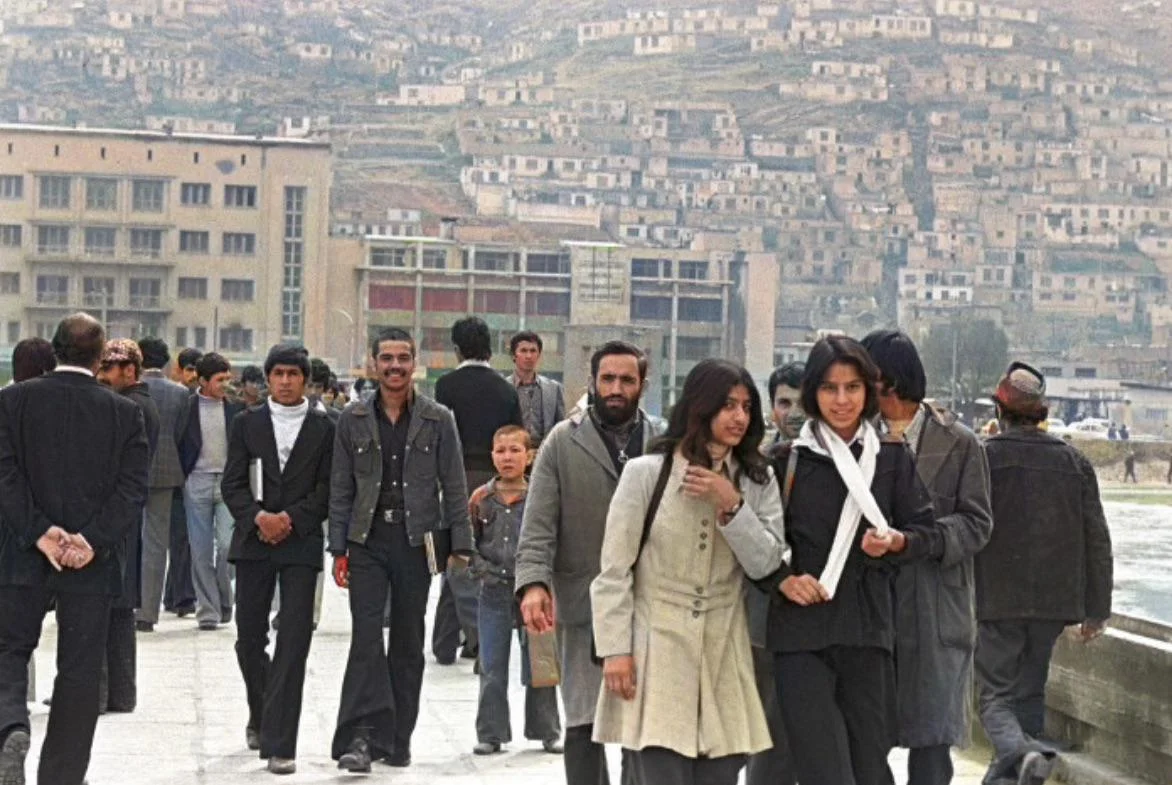
This photograph captures a poignant moment in the history of Kabul, Afghanistan, taken in early 1979. The image depicts a bustling urban scene where men and women are seen walking together in modern, Western-influenced attire, highlighting the social liberalization that characterized the era before the Soviet-Afghan War.
In the background, the hillside housing, typical of Kabul’s topography, overlooks a city that was then experiencing a period of relative modernization under the influence of the People's Democratic Party of Afghanistan (PDPA). However, this peaceful facade masked deep political instability.
By December 1979, the Soviet Union would launch a full-scale invasion to support the communist government against rising Mujahideen insurgencies, fundamentally altering the nation's trajectory. The contrast between the relaxed, hopeful atmosphere of the individuals in the frame and the impending decade of brutal conflict—which would eventually lead to the destruction of much of the city's infrastructure—is stark.
Historical records from this period note that while Kabul enjoyed educational and professional opportunities for women and a secularized public sphere, the rural-urban divide and internal power struggles within the PDPA were reaching a breaking point. This photograph serves as a visual testament to a 'lost' Kabul, a period often remembered for its potential for development before the onset of forty years of continuous warfare.
The image underscores the fragility of social progress in the face of geopolitical maneuvering during the height of the Cold War, reflecting a time when Afghanistan was caught between modernization efforts and the traditionalist resistance that would define its future.