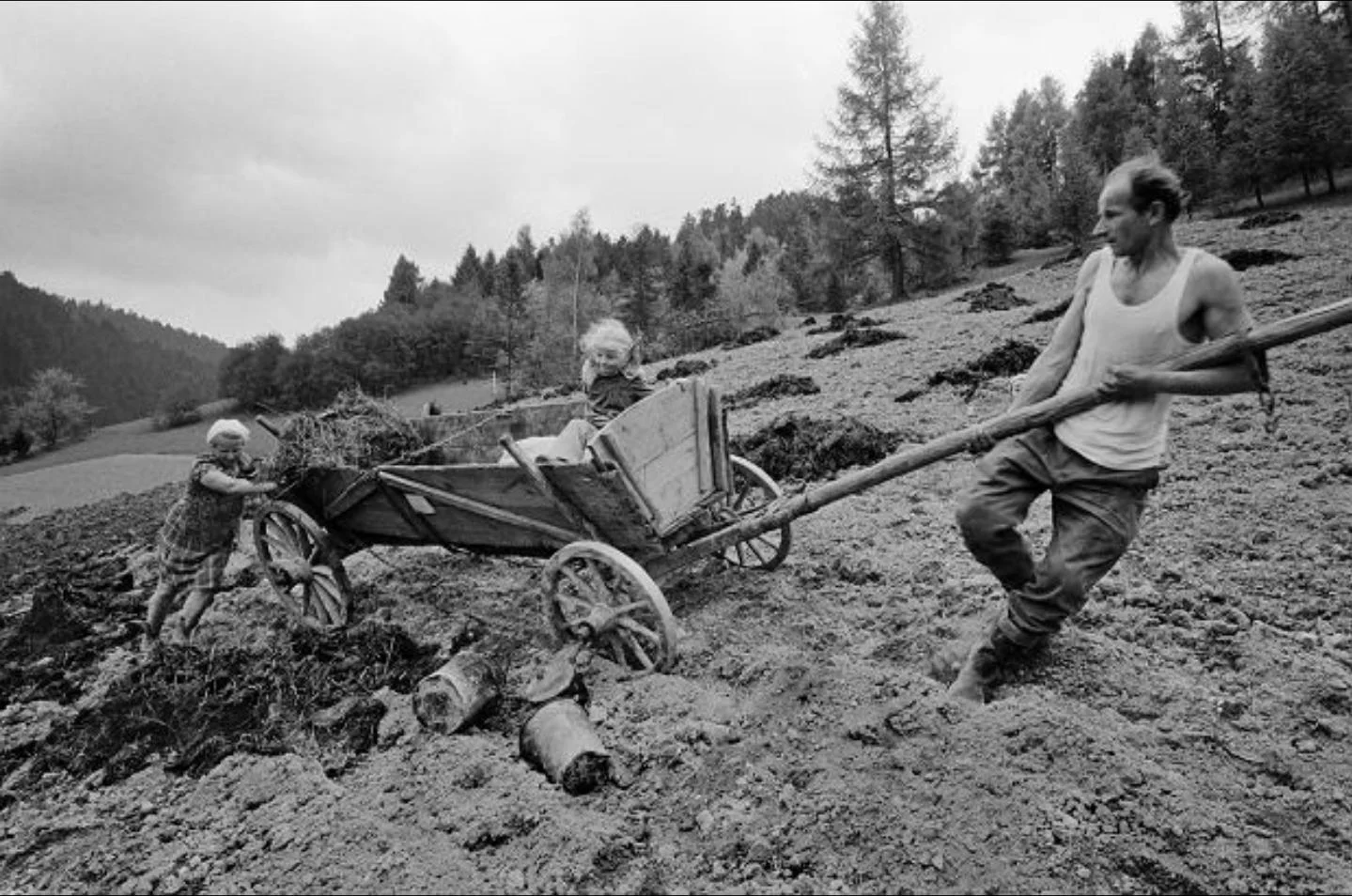
This poignant black-and-white photograph, captured by renowned Polish photographer Marian Schmidt in 1976, offers a stark window into the rural reality of the Polish People's Republic. The image depicts a peasant family in Wierchomla Wielka, a village nestled in the Beskid Sądecki mountains, engaged in the grueling physical labor of manual farming. The central figure is a father pulling a wooden cart through a freshly tilled field, while his wife—reportedly pregnant with their twelfth child—assists from behind, and a young child sits atop the load.
Historically, this image captures the contrast between the state-promoted industrialization of the Communist era and the persistent, traditional agrarian lifestyle that defined much of rural Poland. Despite the rapid modernization attempts by the Polish United Workers' Party, families in mountainous regions like Wierchomla often remained reliant on pre-industrial agricultural methods, characterized by self-sufficiency and high birth rates. The physical exertion visible in the father’s posture and the rugged landscape underscore the socio-economic challenges faced by rural families during the late 1970s, a period marked by mounting economic stagnation that would eventually lead to the rise of the Solidarity movement. Marian Schmidt, known for his intimate documentary style, masterfully captures the resilience and stoicism of the peasantry. This photograph serves as a vital historical document of a vanishing way of life, highlighting the human endurance required to sustain a large family in a harsh, mountainous environment before the socio-political shifts of the 1980s transformed the nation. It stands as a testament to the quiet, often overlooked labor that sustained the country's rural foundation.