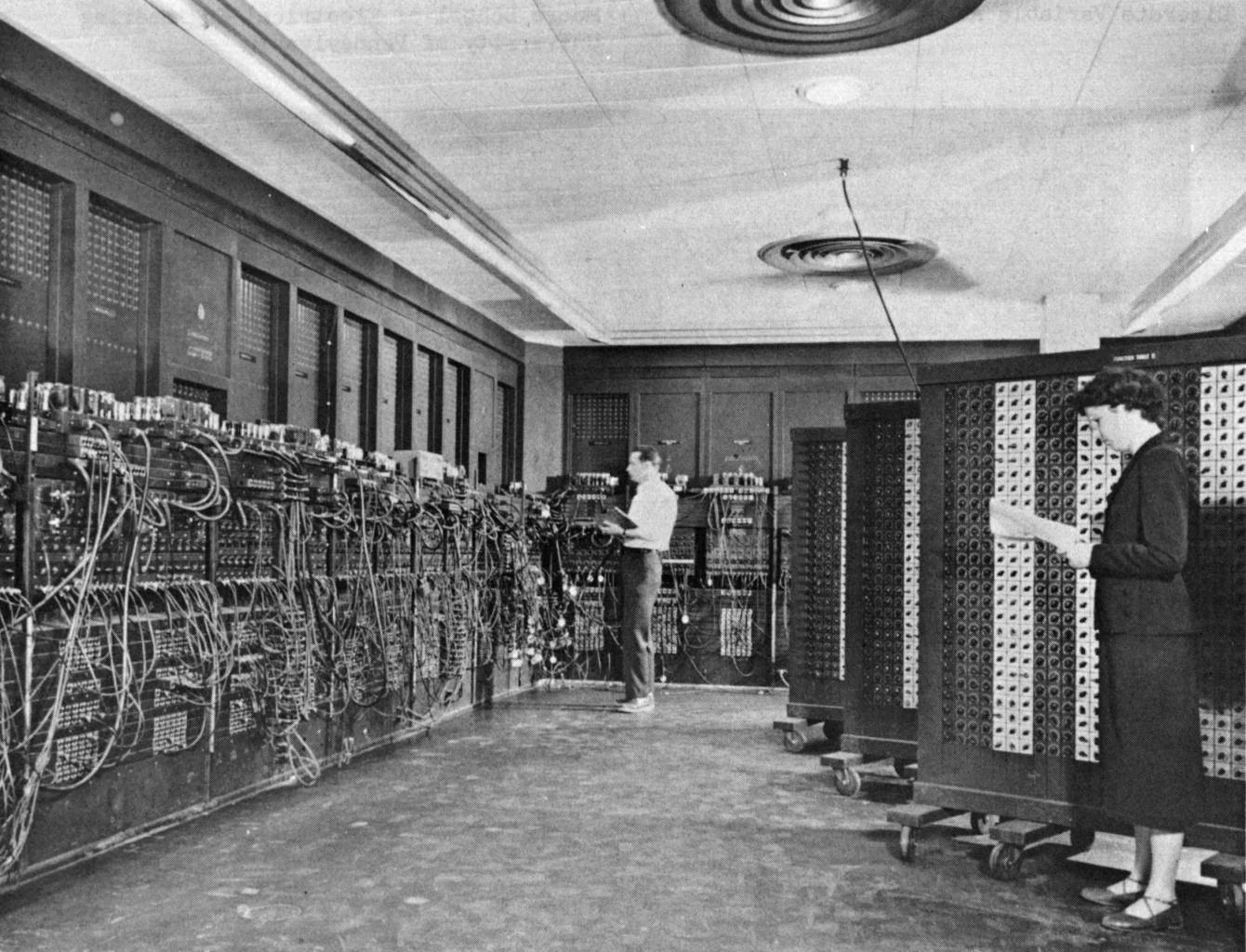
This historic photograph captures the ENIAC (Electronic Numerical Integrator and Computer), the world's first programmable, general-purpose electronic digital computer. Occupying a 1,500-square-foot room at the Moore School of Electrical Engineering at the University of Pennsylvania, the machine was a monumental feat of engineering.
Completed in late 1945 and formally dedicated on February 15, 1946, ENIAC was designed by John Mauchly and J. Presper Eckert to calculate artillery firing tables for the United States Army’s Ballistic Research Laboratory.
The image illustrates the sheer scale of the machine, which featured over 17,000 vacuum tubes, 70,000 resistors, and 10,000 capacitors. Operators are shown configuring the machine, a process that involved manually plugging cables and setting switches, as it lacked the stored-program architecture of later computers.
The women in the photo, often overlooked in early historical accounts, were among the six original programmers—Kay McNulty, Betty Jennings, Betty Snyder, Marlyn Wescoff, Fran Bilas, and Ruth Lichterman—who were instrumental in the machine's operation. By performing calculations 1,000 times faster than electromechanical machines of the era, ENIAC fundamentally transformed scientific research, meteorology, and nuclear physics.
It marked the transition from mechanical calculation to the digital age, setting the foundation for the rapid technological evolution of the 20th century. Sources from the Smithsonian Institution and the University of Pennsylvania archives confirm its status as the ancestor of all modern computing systems.