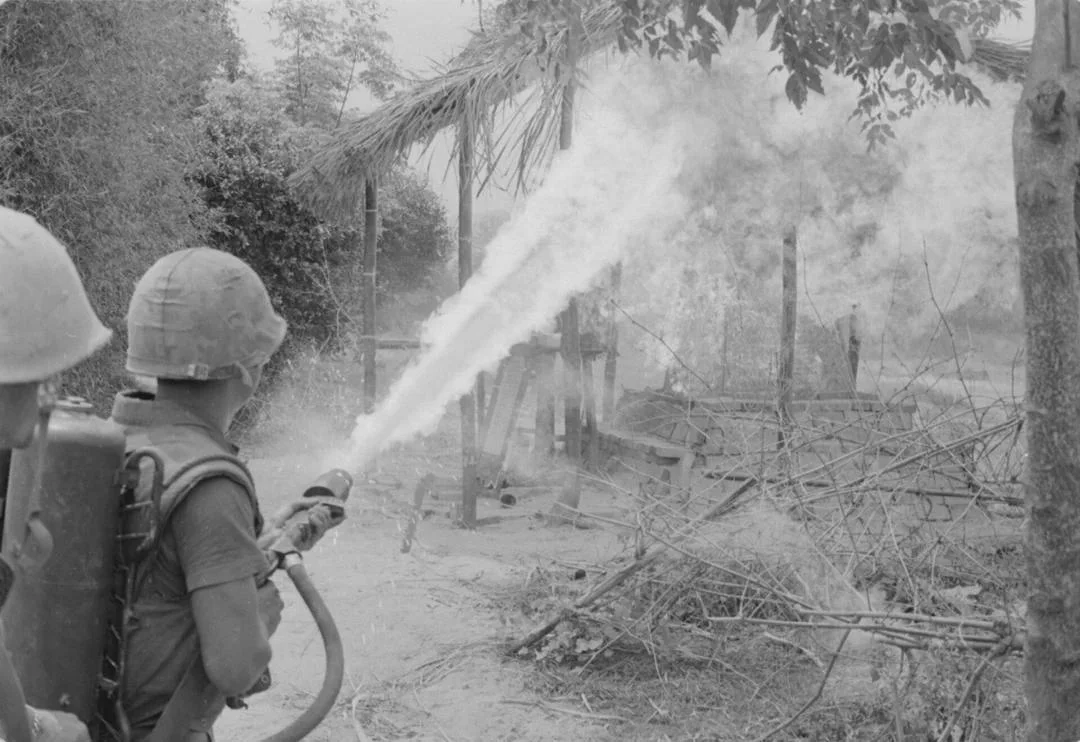
This striking black-and-white photograph captures a quintessential moment of the Vietnam War in 1967, depicting a United States Marine operating an M2A1-7 flamethrower. The soldier is seen clearing a structure, likely part of a Viet Cong supply cache or defensive fortification, using the devastating incendiary weapon.
During the Vietnam conflict, flamethrowers were employed primarily as tactical tools for 'tunnel rat' operations, clearing dense jungle undergrowth, and destroying fortified bunkers that were impervious to small arms fire. The M2A1-7, a man-portable weapon system, utilized thickened fuel—typically napalm—which adhered to targets and burned at extreme temperatures, often exceeding 1,000 degrees Celsius.
The psychological and physical impact of such weaponry was immense, contributing to the brutal nature of the ground war in Southeast Asia. This image serves as a stark historical document of the aggressive tactical maneuvers utilized by U.S. forces to counter the guerrilla warfare tactics of the North Vietnamese Army and the Viet Cong.
The use of incendiary weapons became a subject of intense domestic and international scrutiny, eventually leading to the 1980 UN Convention on Certain Conventional Weapons, which restricted the use of incendiary devices against civilian populations. By analyzing this image, historians can better understand the technological reality of the Vietnam-era infantryman, whose daily life involved high-intensity combat within a complex and unforgiving environment.
The photograph underscores the transition from traditional warfare to the unconventional, high-tech asymmetric conflict that defined the American experience in Vietnam between 1955 and 1975.