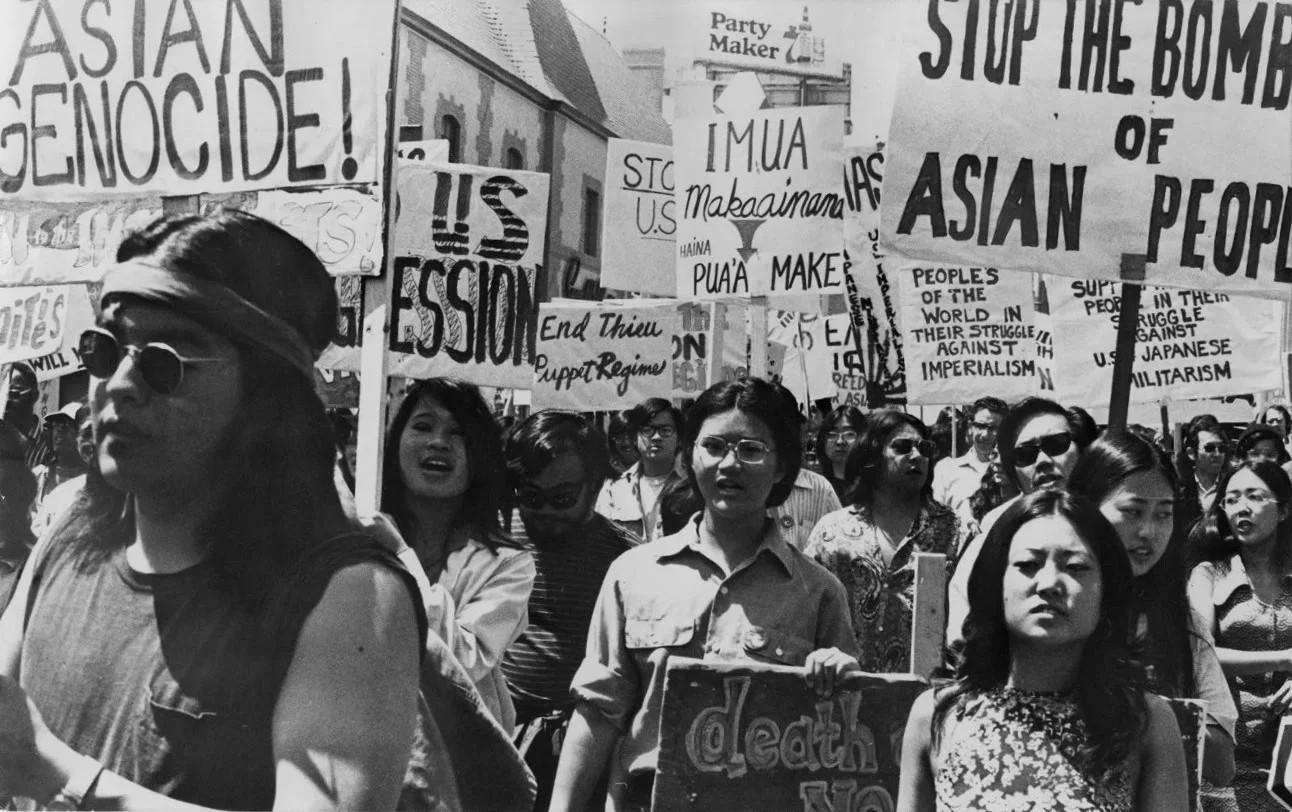
This powerful 1971 photograph captures a significant moment in the Asian American movement, as demonstrators in Los Angeles marched to protest United States involvement in the Vietnam War. The placards, bearing slogans like 'Asian Genocide' and 'End Thieu Puppet Regime,' highlight the specific political consciousness of the era, where Asian Americans began to link the anti-war movement with broader struggles against imperialism and racism.
By the early 1970s, the Asian American Movement had emerged as a distinct political force, moving beyond the 'model minority' myth to challenge U.S. foreign policy in Southeast Asia. The presence of signs mentioning 'Japanese militarism' and 'IMUA' (a Hawaiian term often associated with unity) suggests a coalition of diverse Asian ethnic groups, including Japanese, Chinese, and Filipino Americans, uniting under a banner of Third World solidarity.
This period was marked by massive anti-war mobilizations across the U.S., yet this specific protest reflects the unique perspective of a community that felt the war was an act of aggression against their own ancestral homelands. The significance of this demonstration lies in its contribution to the diversification of the anti-war movement, shifting the narrative from a purely domestic anti-draft protest to a global critique of Western hegemony.
Historically, this aligns with the height of the New Left and the radicalization of ethnic studies programs on American university campuses, which provided the intellectual framework for these protests. These activists challenged the moral authority of the U.S. government, demanding an end to the bombing campaigns that were devastating civilian populations in Vietnam, Cambodia, and Laos.
Their activism remains a cornerstone of Asian American civil rights history, demonstrating a commitment to global justice that continues to influence modern social movements.