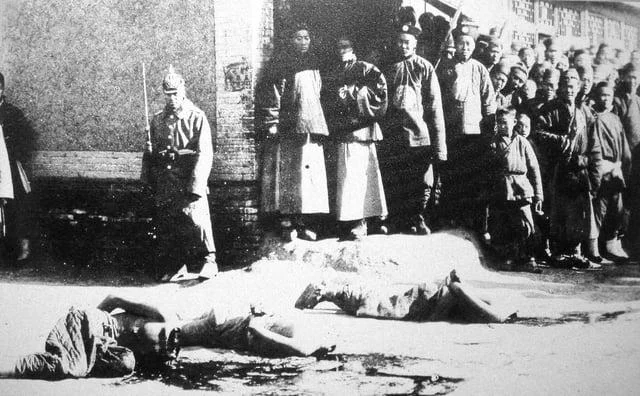
This stark historical photograph, captured circa 1901, depicts a German soldier standing guard over the decapitated remains of Chinese Boxer rebels. The scene takes place in the aftermath of the Boxer Rebellion (1899–1901), an anti-imperialist, anti-colonial, and anti-Christian uprising in China.
The soldier, identifiable by his distinctive Pickelhaube helmet, represents the Eight-Nation Alliance, a coalition of international forces—including Germany, Britain, France, Russia, Japan, the United States, Italy, and Austria-Hungary—that intervened to suppress the rebellion and protect their respective interests in Beijing and Tianjin. Following the relief of the International Legations, foreign troops engaged in punitive expeditions across Northern China, characterized by summary executions and looting.
The presence of local Chinese onlookers in the background, witnessing the brutal display, highlights the atmosphere of terror imposed by foreign powers during this period of 'gunboat diplomacy.' The Boxer Rebellion was a pivotal moment in late Qing Dynasty history, significantly weakening the imperial government and accelerating the decline of dynastic rule, which would ultimately collapse in 1911. This image serves as a grim primary source documenting the harsh realities of colonial intervention, the dehumanization of 'enemy' combatants, and the complex, often violent, intersection of Eastern and Western civilizations at the dawn of the 20th century.
Historical records from the era often suppressed such graphic imagery to maintain the 'civilizing mission' narrative at home, making this photograph an essential, if disturbing, visual record of the conflict's brutal cost.