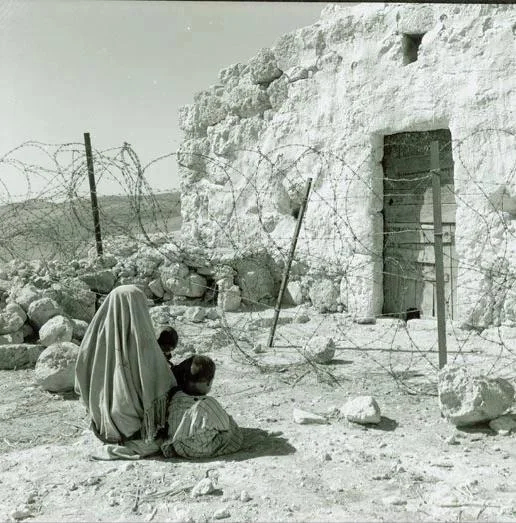
This poignant photograph captures a Palestinian woman and her child sitting before a barbed-wire fence, staring at a home that has been rendered inaccessible. Taken in 1948, the image serves as a powerful visual testament to the Nakba—the displacement of approximately 700,000 Palestinians during the 1948 Arab-Israeli War.
The 'Green Line' refers to the 1949 Armistice Agreements lines, which demarcated the boundaries between Israel and its neighbors (Egypt, Jordan, Lebanon, and Syria) following the conflict. This barrier physically severed communities, agricultural lands, and families, creating a permanent state of exile for many.
The stark contrast between the traditional stone structure—a symbol of ancestral home and stability—and the modern, jagged intrusion of military barbed wire underscores the profound trauma of dispossession. Historians often highlight this period as a foundational moment in the Israeli-Palestinian conflict, marking the start of a multi-generational refugee crisis.
According to UNRWA records, the events of 1948 resulted in the creation of one of the world's longest-standing refugee populations. This photograph is not merely a portrait of individual loss; it is a document of a geopolitical shift that fundamentally altered the demographic and social landscape of the Levant, leaving deep scars that continue to influence international relations and regional stability today.